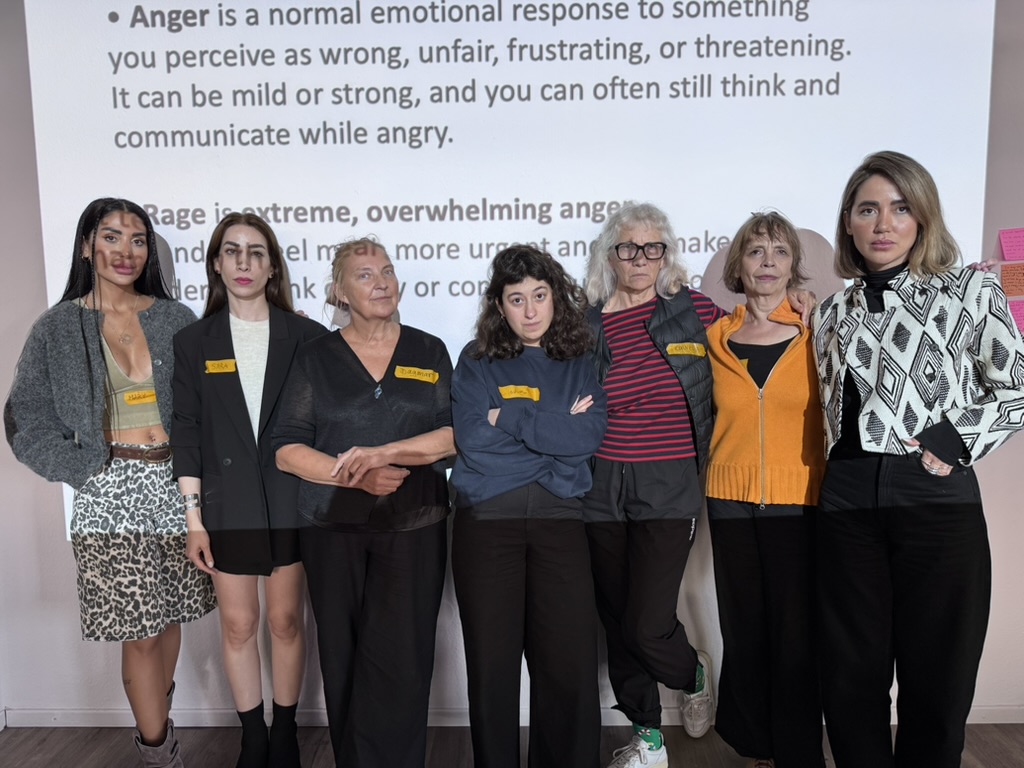
Valerie Solanas’s *SCUM Manifesto* served as the basis for our workshop. Artist Cornelia Sollfrank provided a general introduction to the text, then read excerpts from it and opened them up for discussion within the group.
Valerie Solanas’s SCUM Manifesto is an extremely radical, provocative feminist text from 1967. “SCUM” stands for “Society for Cutting Up Men.” In it, Solanas envisions a society in which men are abolished, and women are liberated from patriarchal structures. It is important to note, however: One should not simply read the text as a serious program for the “murder” of men, nor should one hastily dismiss it as a mere joke. It is precisely this tension that makes it interesting.
The text was written just as the second wave of the women’s movement was emerging. Women were active, for example, in the civil rights and anti-war movements, but increasingly realized that traditional gender hierarchies existed even within these left-wing movements. Solanas articulated something that many feminists at the time felt but rarely said publicly: unbridled anger at male power and at the expectation that women must express their criticism in a reasonable, friendly, and compromising manner. The manifesto therefore became an important, if highly controversial, text for some radical feminists.
However, the workshop was not just about reading the manifesto as a historical document. The group used it as an opportunity to discuss whether things have improved, changed, or even gotten worse since then. Questions included: What do gender hierarchies look like in our society? What can be observed in different cultures? A look at the major political developments of our time allows us to discuss the extent to which deep-seated emotions such as anger and powerlessness are key factors in politics and activism.
In a group discussion, the participants conducted analyses, gathered statements, and formulated demands. In the end, a new manifesto was drafted that expresses hopes for a better future.
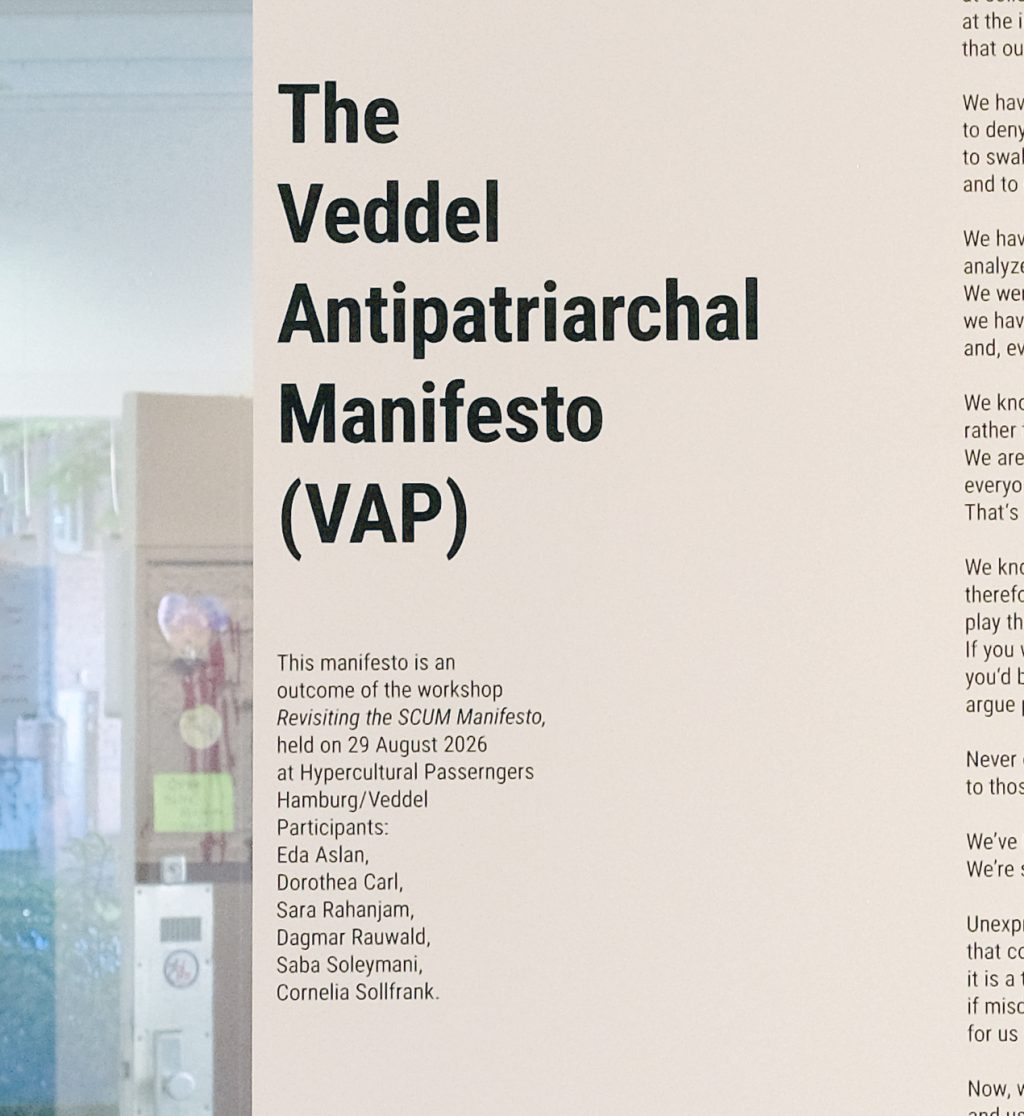
The
Veddel
Antipatriarchal
Manifesto
(VAP)
WE ARE ANGRY.
And we refuse to apologize for it.
Our anger is not irrational.
It is not hysteria.
It is not bitterness.
It is not a failure to be feminine.
Our anger is information.
It tells us where something hurts.
Where something has been violated.
Where a boundary has been crossed.
Where power has been abused.
Where dignity has been denied.
Our anger is a response to injustice,
to patriarchy –
a social system in which men, as a group,
hold greater power and authority than women
and other genders,
in private relationships, in politics, economics,
and social institutions.
Men have more power, privileges, and control.
But of course, not all men are the same,
and they don’t all have the same amount of power either.
And what the hack is a man anyway?
Who cares about chromosomes, genes, or sperm?
We certainly don’t!
But we care for our discrimination and injustice.
Our response is anger.
We have a history with anger.
We have lived with anger,
on anger, beneath anger,
on top of anger.
Anger at ourselves,
and at everyone that treats us unfair,
Angry at our families who pass on their trauma,
at the friends who don‘t have time for us,
at colleagues who undermine our work,
at the institutions that exclude us and make us feel
that our work is worthless.
We have tried to ignore it,
to deny it,
to swallow it.
and to compensate for it.
We have tried to understand our anger,
analyze it, overcome it.
We went on vacation and to therapy,
we have learned yoga and breathing techniques,
and, eventually, gave in to our addictions.
We know how to turn violence against ourselves
rather than make others uncomfortable with our rage.
We are taught to understand
everyone else‘s needs before our own.
That‘s supposed to be ‘femininity.’
We know that our anger is not appreciated,
therefore, we tried to make ourselves acceptable,
play the ‘respectability game.’
If you want to be taken seriously,
you‘d better be reasonable;
argue professionally, preferably with a smile on your face.
Never ever show your true feelings—
to those who walk all over you.
We’ve had enough of this shit.
We’re sick of it!
Unexpressed anger is like an undetonated device
that could go off at any moment;
it is a tremendous source of energy,
if misdirected, it can be deadly,
for us – and the rest of the world.
Now, we are going to tap into it,
and use it for transformation.
We express our anger in all possible ways,
we transform it into art and togetherness,
reaching out to those who are ready
to excavate honesty together with us.
The focus of our work is growth,
leaving our limitations behind,
flying without borders.
We nurture our passions, take them serious,
as much as our enemies take their hatred serious.
Capitalism and patriarchy have taught us
to turn against each other;
exploitation and competition have crippled us.
Racism and colonialism have taught us
that domination is built on discrimination;
‘othering’ has made us all guilty –
more or less.
We have to relearn friendship,
love and solidarity,
and for once, remember human rights;
they belong to every human being.
All human beings are supposed to be free and equal
in dignity and rights,
and no one should be discriminated against
because of their class, skin color, gender, sexuality,
religion, origin, or disability.
That‘s how it should be,
but it’s not how it is!
We show our wounds,
make our vulnerable bodies politically visible;
and thus, create collective action.
Our struggle begins right now, right here;
it starts, where our bodies are,
but it won’t be limited to us and our situation.
This manifesto is an outcome of the workshop Revisiting the SCUM Manifesto,
held on 29 August 2026 at Hypercultural Passengers, Hamburg/Veddel.
Participants: Eda Aslan, Dorothea Carl, Sara Rahanjam, Dagmar Rauwald, Saba Soleymani, Cornelia Sollfrank.
Special thanks to Magdalena Goetz, Christina Grammatikopoulou, Jasmine Hariri, Sara Ahmed and Audre Lorde.
© by the Authors

With the kind support of the
Hamburg Ministry of culture and Media /
and the Hamburg-Mitte District Office