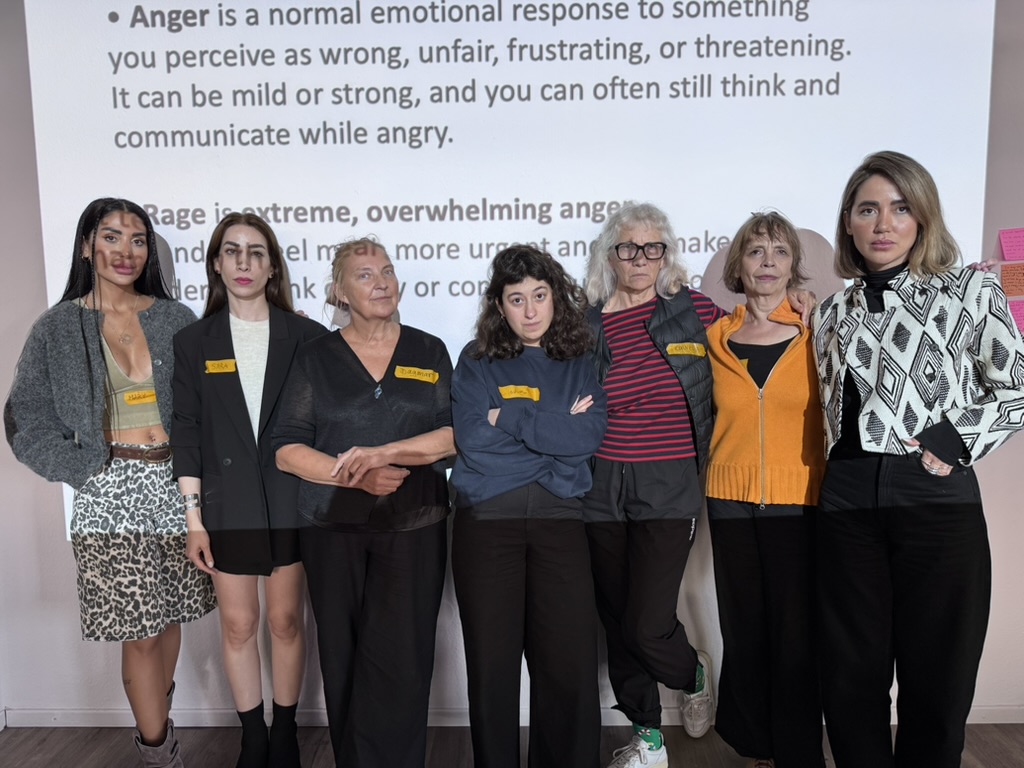
Das SCUM Manifesto von Valerie Solanas in englischer Sprache diente als Grundlage für unseren Workshop. Die Künstlerin Cornelia Sollfrank gab eine allgemeine Einführung in den Text, las anschließend Auszüge daraus und stellte sie in der Gruppe zur Diskussion.
Das SCUM Manifesto von Valerie Solanas ist ein extrem radikaler, provokanter feministischer Text von 1967. „SCUM“ steht für „Society for Cutting Up Men“ – also etwa „Gesellschaft zur Abschaffung von Männern“. Solanas entwirft darin eine Gesellschaft, in der Männer abgeschafft und Frauen von patriarchalen Strukturen befreit werden. Wichtig ist allerdings: Man sollte den Text nicht einfach als ernst gemeintes Programm zur „Ermordung“ von Männern lesen, aber auch nicht vorschnell als bloßen Witz abtun. Genau diese Spannung macht ihn interessant.
Der Text wurde geschrieben, als gerade die zweite Frauenbewegung entstand. Frauen engagierten sich beispielsweise in der Bürgerrechts- und Antikriegsbewegung, stellten jedoch zunehmend fest, dass auch innerhalb dieser linken Bewegungen traditionelle Geschlechterhierarchien existierten. Solanas formulierte etwas, das viele Feministinnen damals zwar empfanden, aber kaum öffentlich sagten: ungebremste Wut auf männliche Macht und auf die Erwartung, Frauen müssten ihre Kritik vernünftig, freundlich und kompromissbereit äußern. Das Manifest wurde deshalb für einige radikale Feministinnen zu einem wichtigen, wenn auch höchst umstrittenen Text.
In dem Workshop ging es aber nicht nur darum, das Manifest als historisches Dokument zu lesen. Die Gruppe nahm es zum Anlass, zu diskutieren, ob sich seitdem etwas verbessert, verändert oder sogar verschlechtert hat. Fragen waren u.a.: Wie sehen Geschlechterhierarchien in unserer Gesellschaft aus? Was kann man in unterschiedlichen Kulturen beobachten? Ein Blick auf die großen politischen Entwicklungen unserer Zeit erlaubt, darüber zu sprechen, inwiefern tief liegende Affekte wie Wut und Ohnmacht wesentliche Faktoren der Politik und des Aktivismus sind.
In einer gemeinsamen Diskussion führten die Teilnehmerinnen Analysen durch, sammelten Aussagen und stellten Forderungen. Am Ende wurde ein neues Manifest formuliert, das Wünsche für eine schönere Zukunft zum Ausdruck bringt.
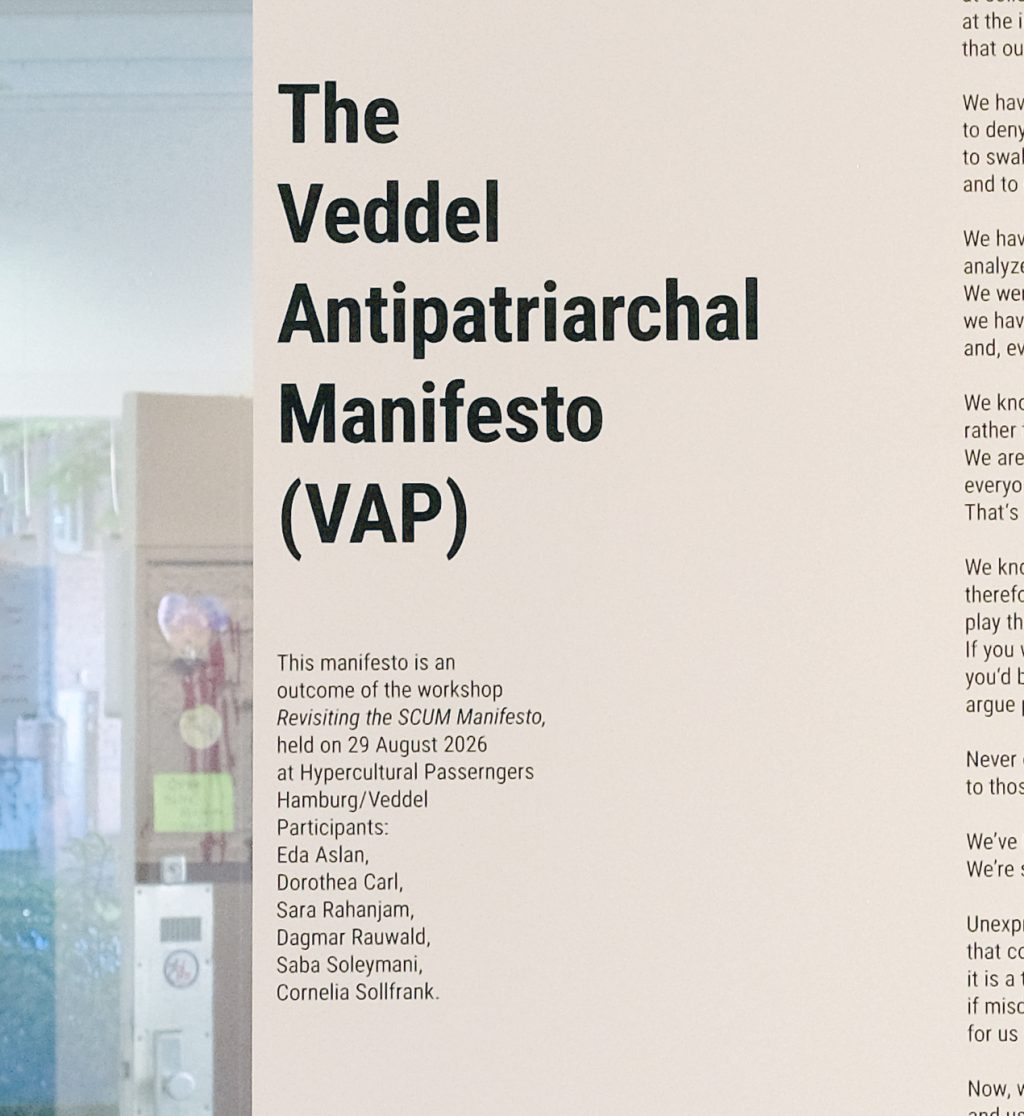
The
Veddel
Antipatriarchal
Manifesto
(VAP)
WE ARE ANGRY.
And we refuse to apologize for it.
Our anger is not irrational.
It is not hysteria.
It is not bitterness.
It is not a failure to be feminine.
Our anger is information.
It tells us where something hurts.
Where something has been violated.
Where a boundary has been crossed.
Where power has been abused.
Where dignity has been denied.
Our anger is a response to injustice,
to patriarchy –
a social system in which men, as a group,
hold greater power and authority than women
and other genders,
in private relationships, in politics, economics,
and social institutions.
Men have more power, privileges, and control.
But of course, not all men are the same,
and they don’t all have the same amount of power either.
And what the hack is a man anyway?
Who cares about chromosomes, genes, or sperm?
We certainly don’t!
But we care for our discrimination and injustice.
Our response is anger.
We have a history with anger.
We have lived with anger,
on anger, beneath anger,
on top of anger.
Anger at ourselves,
and at everyone that treats us unfair,
Angry at our families who pass on their trauma,
at the friends who don‘t have time for us,
at colleagues who undermine our work,
at the institutions that exclude us and make us feel
that our work is worthless.
We have tried to ignore it,
to deny it,
to swallow it.
and to compensate for it.
We have tried to understand our anger,
analyze it, overcome it.
We went on vacation and to therapy,
we have learned yoga and breathing techniques,
and, eventually, gave in to our addictions.
We know how to turn violence against ourselves
rather than make others uncomfortable with our rage.
We are taught to understand
everyone else‘s needs before our own.
That‘s supposed to be ‘femininity.’
We know that our anger is not appreciated,
therefore, we tried to make ourselves acceptable,
play the ‘respectability game.’
If you want to be taken seriously,
you‘d better be reasonable;
argue professionally, preferably with a smile on your face.
Never ever show your true feelings—
to those who walk all over you.
We’ve had enough of this shit.
We’re sick of it!
Unexpressed anger is like an undetonated device
that could go off at any moment;
it is a tremendous source of energy,
if misdirected, it can be deadly,
for us – and the rest of the world.
Now, we are going to tap into it,
and use it for transformation.
We express our anger in all possible ways,
we transform it into art and togetherness,
reaching out to those who are ready
to excavate honesty together with us.
The focus of our work is growth,
leaving our limitations behind,
flying without borders.
We nurture our passions, take them serious,
as much as our enemies take their hatred serious.
Capitalism and patriarchy have taught us
to turn against each other;
exploitation and competition have crippled us.
Racism and colonialism have taught us
that domination is built on discrimination;
‘othering’ has made us all guilty –
more or less.
We have to relearn friendship,
love and solidarity,
and for once, remember human rights;
they belong to every human being.
All human beings are supposed to be free and equal
in dignity and rights,
and no one should be discriminated against
because of their class, skin color, gender, sexuality,
religion, origin, or disability.
That‘s how it should be,
but it’s not how it is!
We show our wounds,
make our vulnerable bodies politically visible;
and thus, create collective action.
Our struggle begins right now, right here;
it starts, where our bodies are,
but it won’t be limited to us and our situation.
This manifesto is an outcome of the workshop Revisiting the SCUM Manifesto,
held on 29 August 2026 at Hypercultural Passengers, Hamburg/Veddel.
Participants: Eda Aslan, Dorothea Carl, Sara Rahanjam, Dagmar Rauwald, Saba Soleymani, Cornelia Sollfrank.
Special thanks to Magdalena Goetz, Christina Grammatikopoulou, Jasmine Hariri and Audre Lorde.
© by the Authors
Mit freundlicher Unterstützung der
Behörde für Kultur und Medien Hamburg/
und dem Bezirksamt Hamburg Mitte